Quick identification facts
Dog Tick Field Check Tool
Review these ten observable traits to evaluate whether the tick you found matches an American dog tick or brown dog tick.
Which Dog Tick Are You Looking At?
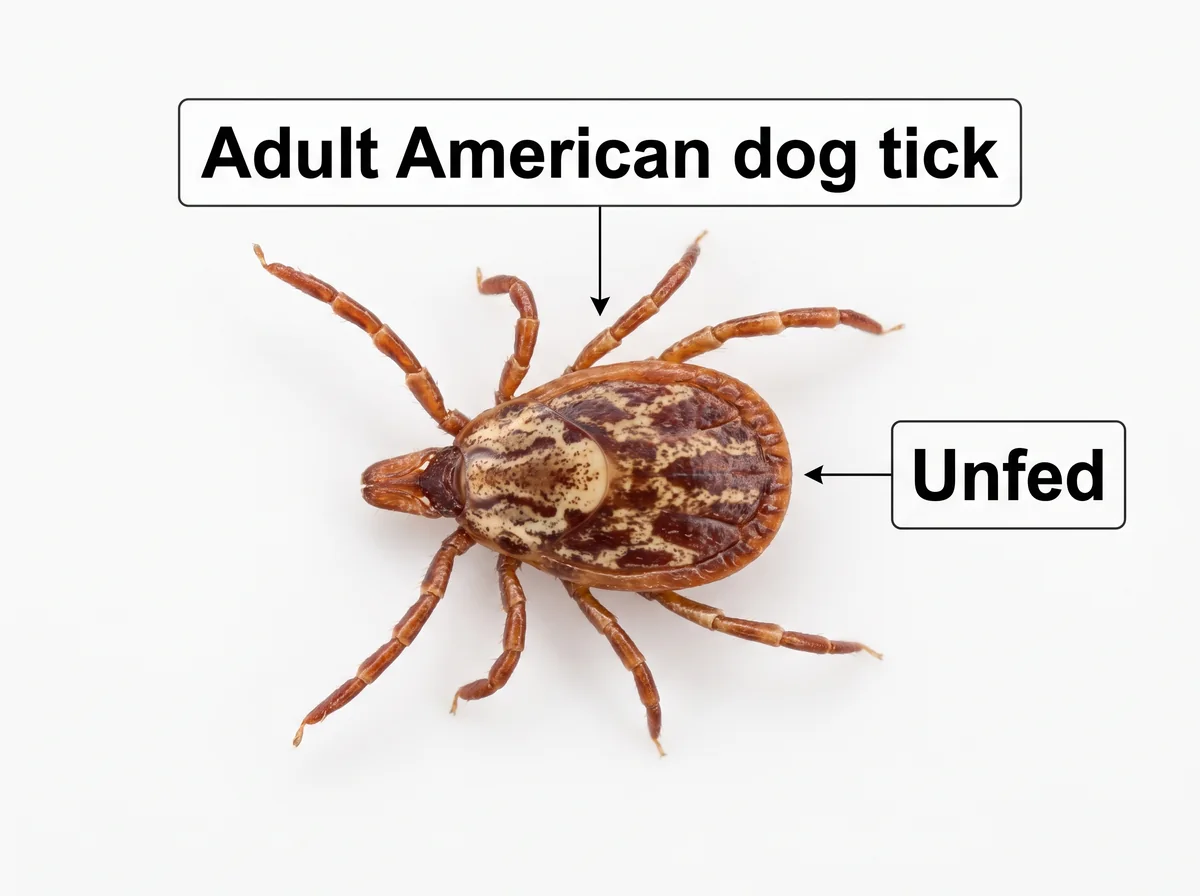
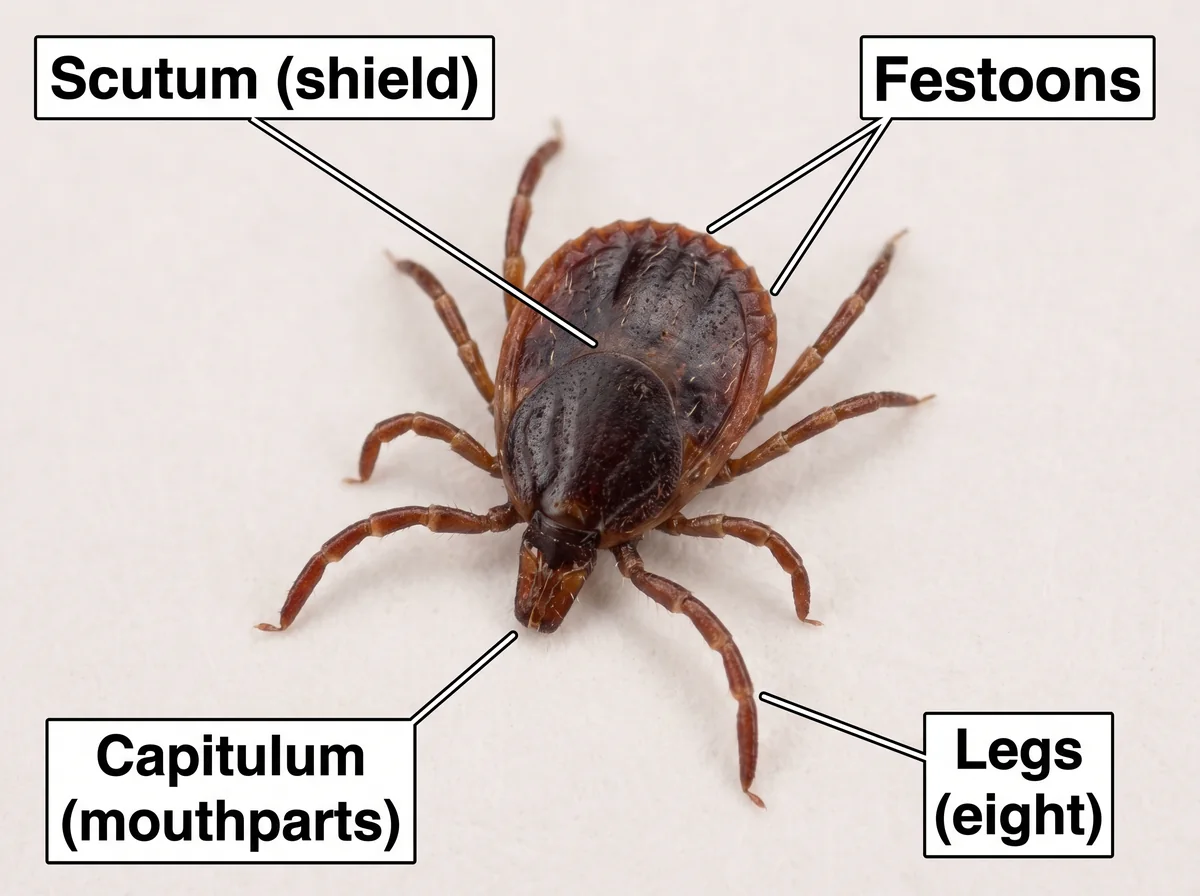
In North America, the name dog tick usually refers to two distinct species: the American dog tick and the brown dog tick. When you want to tell them apart, look closely at the pattern on the back shield, called the scutum. On female American dog ticks, this shield sits right behind the head area and shows a bright cream or off-white color that contrasts against a dark reddish-brown body. On male American dog ticks, this cream-and-gray mottled pattern extends across the entire back.
Brown dog ticks look noticeably plainer when you check them under direct light. Both males and females have a uniform reddish-brown body without any white, silver, or cream markings. On male brown dog ticks, the shield covers the entire upper surface, while on females it covers only the small area directly behind the mouthparts. If you find a tick indoors along baseboards or inside dog bedding, you are likely looking at a brown dog tick, as they thrive in human structures.
- Female American dog tick: Cream-colored shield on the front third; dark brown rear body.
- Male American dog tick: Diffuse cream-and-gray mottled pattern over the whole back.
- Brown dog tick (both sexes): Plain reddish-brown without white patches or mottling.
- Rear body edge: American dog ticks show distinct segmented notches known as festoons.
When you find an unfamiliar tick on your dog and need fast visual confirmation, you can explore the Insectio tick guide to compare your specimen against clear reference photographs.
How Big Is a Dog Tick Compared to Other Ticks?
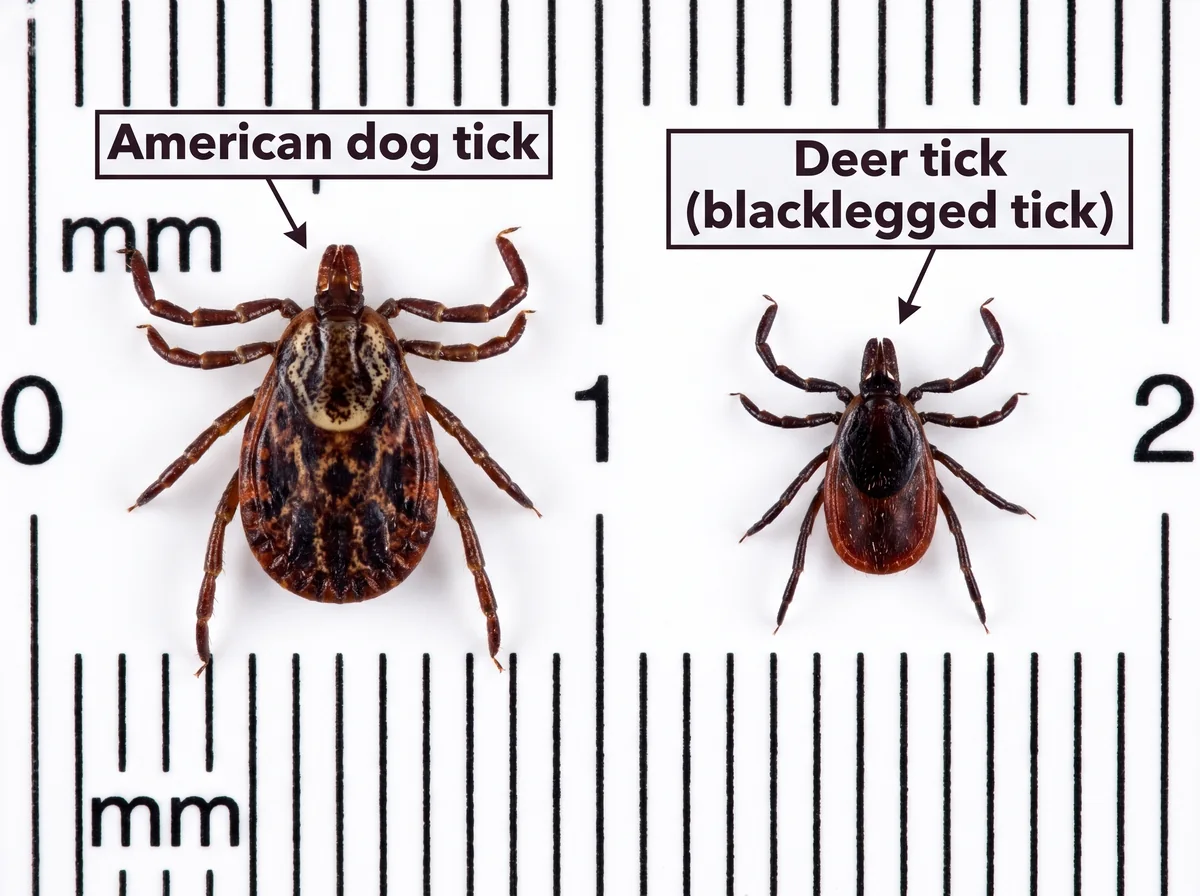
Size is one of the easiest clues you can use to separate dog ticks from other common species you might pull off your pet or clothing. Unfed adult American dog ticks measure about one-quarter inch long. Female American dog ticks average about 3.8 mm long and 2.5 mm wide, while unfed males average 1.43 mm long and 1.01 mm wide. This makes them roughly double the size of adult deer ticks, which are tiny and roughly the size of a sesame seed.
When you examine an attached tick, keep in mind that its size changes dramatically once it begins feeding. As a female dog tick takes a blood meal, her body stretches to accommodate the blood. A fully engorged female American dog tick can reach up to 15 mm long (about half an inch) and 10 mm wide. At this stage, she can weigh over one gram and often looks like a smooth, gray-brown or dark pinto bean with tiny legs clustered near the front.
- Larva (6 legs): Pinhead-sized, measuring roughly 0.60 mm by 0.40 mm.
- Nymph (8 legs): About twice larva size, measuring roughly 0.9 mm by 0.8 mm.
- Unfed Adult (8 legs): About 1/4 inch long (1.4 mm to 3.8 mm depending on sex).
- Engorged Adult Female: Expands up to 1/2 inch (15 mm) long and 10 mm wide.
Where Can You Expect to Encounter Dog Ticks?
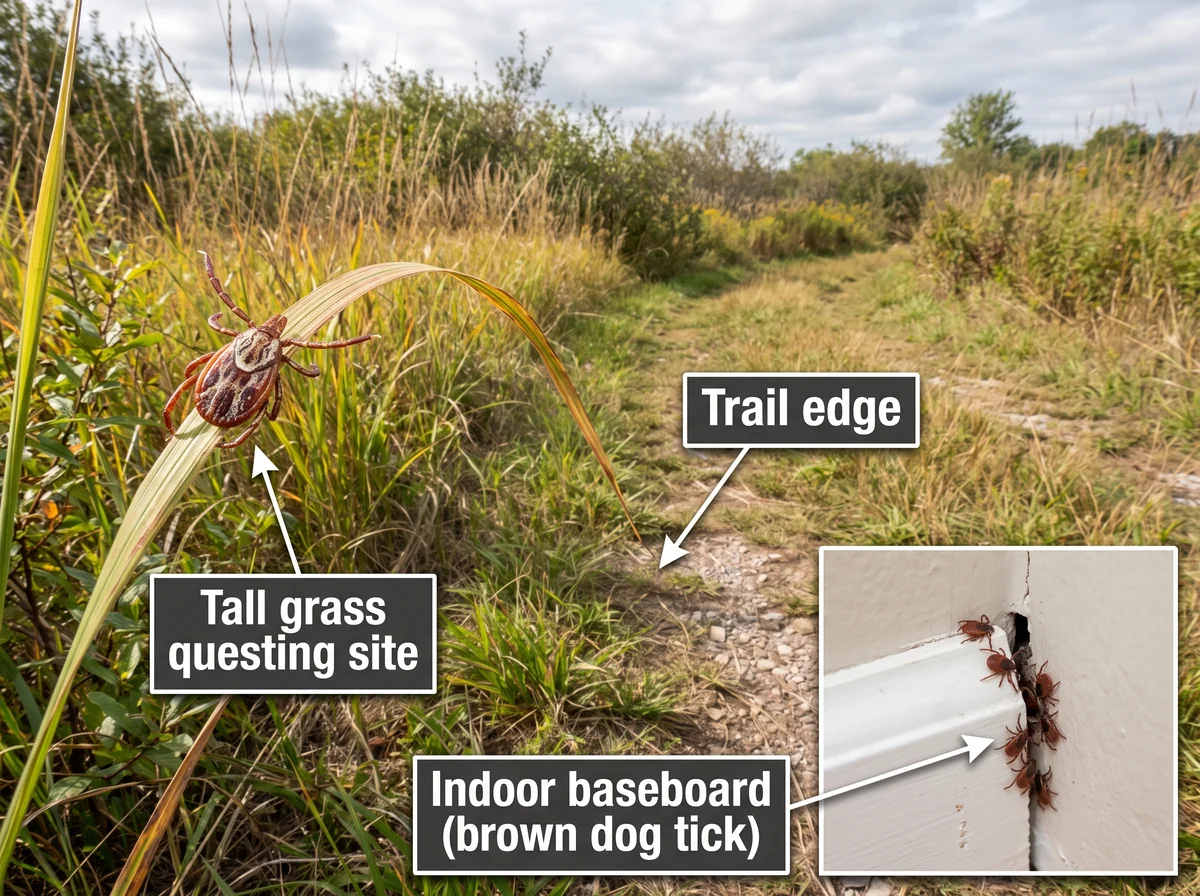
American dog ticks thrive in open, sunlit outdoor environments rather than deep, closed-canopy woods. You are most likely to encounter them along forest edges, overgrown scrubland, grassy agricultural fields, roadsides, and the edges of hiking paths. Their geographic range extends from Atlantic coastal states westward to the Rocky Mountains, as well as parts of California, Oregon, Washington, Canada, and Mexico. They climb onto tall grass and wait for passing hosts like dogs, raccoons, or hikers.
Brown dog ticks have a very different habitat preference and can be found across the entire United States, Hawaii, and worldwide. They are uniquely adapted to live and reproduce indoors. In the northeastern states, brown dog ticks are found almost exclusively inside homes, dog kennels, and veterinary facilities. If you are finding ticks climbing your curtains, crawling along baseboards, hiding behind window frames, or resting under furniture cushions, you are dealing with brown dog ticks.
- Outdoor zones: Sunny trail edges, open fields, walkways, and scrub borders.
- Indoor zones: Baseboards, wall gaps, door moldings, dog crates, and furniture seams.
- Host range for young stages: American dog tick larvae and nymphs feed on mice, voles, and chipmunks.
- Host range for adults: American dog ticks prefer larger mammals including dogs and humans.
How Does the Dog Tick Life Cycle Work?
When you follow the American dog tick life cycle, you will find four distinct stages: egg, larva, nymph, and adult. It is a three-host tick, which means it must drop off its host after feeding at each stage, molt in the environment, and attach to an entirely new animal for its next meal. After hatching from eggs in the leaf litter, tiny six-legged larvae overwinter and seek out small rodents in the spring. Once fed, they molt into eight-legged nymphs, feed on another small mammal, and molt into adults.
In nature, completing this entire life cycle typically takes about two years, though it can range from three months to three years depending on temperature and host availability. Adult females lay thousands of eggs in ground debris, usually during the fall, and then die. If you are dealing with unfed adult American dog ticks outdoors, they possess remarkable endurance and can survive for up to two years (around 1,000 days) without finding a host.
- Stage 1: Eggs laid in soil or leaf litter during late summer or fall.
- Stage 2: Six-legged larvae hatch, overwinter, and feed on mice or voles.
- Stage 3: Eight-legged nymphs feed on small mammals before molting into adults.
- Stage 4: Adults feed, mate on larger hosts, and females detach to lay eggs.
If your photo still leaves you unsure, check the visible clues with BugKnow for another side-by-side comparison.
Which Look-Alike Ticks Might Confuse You?
Several common tick species share overlapping territory with dog ticks, so you will want to compare them carefully. The blacklegged tick, or deer tick, is significantly smaller than an American dog tick at every stage. When you examine an adult female deer tick, you will see a distinct reddish-orange body with a solid black shield and solid black legs, lacking any of the mottled white or cream markings found on American dog ticks.
The lone star tick is another frequent look-alike you might encounter in brushy areas. You can easily separate adult female lone star ticks by the single, prominent white or silvery dot centered on their backs, rather than the broad cream shield of a female American dog tick. Rocky Mountain wood ticks share a similar mottled silver-gray pattern with American dog ticks but are primarily separated by their specific mountainous geographical range.
- Deer Tick: Half the size of a dog tick, solid dark scutum, reddish abdomen, and black legs.
- Lone Star Tick: Central silvery star on female shield; fast-moving in sunny grass.
- Rocky Mountain Wood Tick: Very similar mottled pattern; found in high-elevation western regions.
- Brown Dog Tick: Plain reddish-brown, narrow shape, with no white scutum markings.
What Diseases and Health Risks Do Dog Ticks Carry?
Dog ticks are medically important vectors for several serious pathogens that can affect you and your pets. The American dog tick is the primary carrier of Rocky Mountain spotted fever in the eastern United States and also transmits tularemia. Rocky Mountain spotted fever is a severe bacterial illness with a mortality rate exceeding 20% if left untreated. In rare cases, feeding female American dog ticks can also cause canine tick paralysis through neurotoxins in their saliva.
Brown dog ticks carry their own set of health threats. In the southwestern United States and along the U.S.-Mexico border, brown dog ticks have emerged as significant vectors of Rocky Mountain spotted fever. They also transmit canine ehrlichiosis (Ehrlichia canis) and canine babesiosis (Babesia canis) to pets. Notably, neither American dog ticks nor brown dog ticks transmit Lyme disease; that pathogen is spread exclusively by blacklegged deer ticks. Because dog ticks feed slowly over several days, checking your body and pets promptly reduces disease transmission risks.
- Rocky Mountain spotted fever: Transmitted by both American dog ticks and brown dog ticks.
- Tularemia: Can be passed to humans and animals by American dog ticks.
- Canine ehrlichiosis & babesiosis: Common blood disorders spread to dogs by brown dog ticks.
- Lyme disease: Not transmitted by dog ticks; only spread by blacklegged deer ticks.
How Can You Safely Check and Protect Your Pets?
Preventing tick bites begins with regular inspections whenever your dog returns from outdoor walks. Feel slowly through your dog's coat with your fingers, pressing gently down to the skin. Pay special attention to quiet, warm hiding spots where dog ticks prefer to settle: inside and behind the ears, between the paw pads, under the collar, around the groin, and under the front legs.
If you discover a tick attached to your dog or yourself, use fine-tipped tweezers to grasp the tick as close to the skin surface as possible. Pull upward with steady, even pressure without twisting or jerking. Never crush the tick's body or apply heat, oils, or petroleum jelly, as these methods can cause the tick to regurgitate fluids into the bite wound. Wash the bite area thoroughly with soap and water after removal.
- Check high-risk areas: Focus on ears, neck, armpits, belly, and between toes.
- Use fine-tipped tweezers: Grasp near the mouthparts at skin level.
- Pull straight out: Apply steady pressure without twisting or squeezing the swollen abdomen.
- Clean the skin: Disinfect the bite site and wash your hands thoroughly.
To confirm whether a specimen is a dog tick or another biting pest, you can identify a bug by photo using your phone to upload an instant close-up image.
Look-alike Comparator
Compare visual traits between dog ticks and the most common look-alike species encountered on pets and clothing.
Is It Harmful?
Check observable exposure signs to determine appropriate next steps for tick bites and pet safety.
Explore the complete Dog Tick guide
American Dog Tick Identification: What Does It Look Like?
identify the American dog tick specifically by color, shield pattern, and size
appearanceBrown Dog Tick Identification: What Does It Look Like?
identify the brown dog tick and understand its indoor habits
comparisonDog Tick vs Deer Tick: What's the Difference?
tell a dog tick apart from a deer tick
comparisonWood Tick vs Dog Tick: What's the Difference?
clarify whether wood tick and dog tick are the same species and compare to other look-alikes
otherDog Tick Size: How Big Is It?
find exact size measurements for dog ticks unfed and engorged, at every life stage
life cycleDog Tick Life Cycle: How Does It Develop?
understand the egg-larva-nymph-adult stages and how long the cycle takes
eggsDog Tick Eggs: What Does It Look Like?
identify tick eggs and understand whether ticks lay eggs directly on a dog
appearanceEngorged Dog Tick: What Should You Know?
identify a full, blood-fed tick found on a dog
appearanceDog Tick Larvae and Nymphs: What Should You Know?
identify immature dog tick life stages that are often mistaken for other insects
signsDog Tick Bite Identification: What Does It Look Like?
identify a fresh or healing dog tick bite mark on skin
signsHow to Check Your Dog for Ticks?
learn a practical method for inspecting a dog's body for ticks
habitatDog Tick Habitat: Where Does It Live?
understand where dog ticks live outdoors and how dogs pick them up
harmDog Tick Diseases: What Should You Know?
learn what diseases dog ticks can transmit and how serious they are
preventionDog Tick Prevention: How Can You Avoid It?
find general, safe ways to prevent ticks on dogs
seasonalityDog Tick Season: What Should You Know?
learn the seasonal activity pattern of dog ticks
signsRemoving a Tick from a Dog: What Should You Know?
find safe general guidance for removing an attached tick from a dog
faqTick or Skin Tag on Dog: What Should You Know?
figure out whether a bump on a dog's skin is an attached tick or something else like a skin tag
Frequently asked questions
Can dog ticks transmit Lyme disease to people or pets?
No, dog ticks do not transmit Lyme disease. That bacterial infection is spread exclusively by blacklegged ticks (deer ticks). However, American dog ticks and brown dog ticks transmit other serious bacterial illnesses, including Rocky Mountain spotted fever, tularemia, canine ehrlichiosis, and canine babesiosis.
Can dog ticks live and multiply inside my house?
Brown dog ticks can complete their entire life cycle indoors, infesting baseboards, wall gaps, door frames, and dog beds. American dog ticks, however, require outdoor humidity and small rodent hosts for their early stages, so they cannot establish permanent indoor breeding populations.
How long does a dog tick need to stay attached to transmit disease?
Dog ticks are slow feeders that attach firmly and feed over several days. Disease transmission is rarely instantaneous and typically requires several hours of attachment. Removing attached ticks promptly during daily checks significantly reduces the risk of bacterial transmission.
How do you tell a dog tick from a deer tick?
Adult dog ticks are roughly twice the size of deer ticks, measuring about one-quarter inch unfed. Dog ticks have reddish-brown bodies with cream or whitish shield patterns, whereas deer ticks have solid black shields, solid black legs, and unpatterned reddish bodies.
What does an engorged dog tick look like?
A fully blood-fed female dog tick expands up to half an inch (15 mm) long and 10 mm wide. Her abdomen swells into a smooth, rounded, gray-brown oval resembling a dark pinto bean, while her tiny legs remain grouped at the very front.
How long can an adult American dog tick live without food?
Adult American dog ticks are extremely resilient. An unfed adult can survive in outdoor brush and leaf litter for up to two years (roughly 1,000 days) while waiting for a suitable medium or large host animal to brush past.